

.jpg?height=400&name=Post%20Banner%20(12).jpg)
Surface treatment processes that rely on immersion typically require substantial amounts of water to ensure thorough rinsing between process tanks. Operations such as cleaning/degreasing, pickling, etching, and conversion coatings are usually arranged in multi-tank sequences with dedicated rinse tanks between each step.
As an example, consider a simple titanium etching process that is used in jet engine manufacturing, consisting of the following steps:
- Alkaline cleaning
- Cold water rinse
- Titanium etch with nitric and hydrofluoric acids
- Cold water rinse
- Hot water rinse to aid drying
For process consistency, the high-pHalkaline cleaner must be thoroughly rinsed before proceeding to the low-pHacid etch stage. Without water conservation methods, effective rinsing typically requires 0.25–0.5 gallons of water per square foot of part surface area. This requirement increases when drag-out is higher, such as when liquid pools on the parts and carries over into the next step.
Over time, rinse water becomes increasingly contaminated as process solution is carried into the tank. To maintain the required level of purity, deionized (DI) water must be continuously added while the tank is overflowing, allowing dilution to restore the desired rins equality. Both the DI water supply and the overflow discharge incur associated costs, making water management a crucial consideration in process design.
Water conservation methods can significantly reduce rinsing costs by lowering both DI water usage and overflow discharge. Proper drainage over the process tank—improved by tilting, rotating, or correctly orienting the parts—helps minimize drag-out. A spray rinse above the process tank can further recover the solution and return it to the bath.
Wetting agents, or surfactants, can lower surface tension, allowing solutions to drain more effectively from the part surface into the tank.
Installing flow control valves and conductivity sensors can enable adjusting the rinse water flow to match the throughput.
Maintaining bath concentrations more tightly by frequent monitoring and dosing also helps reduce the need for frequent dumps.
Although this BLOG mainly addresses surface treatment using immersion baths, many of the techniques mentioned canalso be applied to spray washers. For example, incorporating freshwater rinses with recovery into the process tank, followed by a recirculating rinse, demonstrates how water consumption can be minimized in spray washer operations. Additionally, water use can be further decreased by employing counter-flow rinses to compensate for evaporation and maintain the cleanliness of the recirculating rinse tank.
The most effective approach is double rinsing in a cascade arrangement, which can reduce freshwater consumption by approximately 80-90 percent. In this setup, the first rinse acts as a “recovery” tank—its water (chemically enriched from drag-out) provides makeup for the process tank. Then, the makeup of the first rinse is drawn fromthe second rinse, and virgin DI water makes up the second rinse. Thesetransfers can be achieved by overflowing or by pumping.
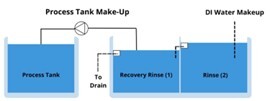
To further reduce the cost of rinse water, we will discuss the following water recycling methods.
- Evaporation
- Ion exchange
- Closed-loop DI
Evaporation—specifically mechanical vapour recompression (MVR)—is an energy-efficient method of concentrating impurities while producing a clean distillate, which can be reused or discharged. MVR typically recovers up to 95% of contaminated rinse water. The upfront cost of MVR is easily justified by the savings in energy andwaste treatment operating costs over the course of a year.
The distillate can then be further polishedby ion exchange to yield pure water for reuse in the process. Thiscombination is by far the most cost-effective solution for high-production applications. It is always preferable to neutralize the rinse water before evaporation, as highly acidic or caustic water can corrode piping, pumps, and downstream treatment equipment.
Closed-loop DI is yet another strategyin which the rinse tank is directly connected to the ion exchange tanks. Water quality can be maintained by automating the flow through the DI beds using aconductivity meter. Although this approach is equally efficient, in large-scale production, operating costs may be significantly higher than those of theMVR/DI setup.
A Note on Sustainability
Water recycling reduces the overall environmental impact by lowering fresh water demand, minimizing wastewater discharge, and lowering costs. It positions manufacturers as leaders in responsible production by supporting ESG objectives, circular economy principles, and consumer demands for sustainable operations.
In Conclusion
In addition to lowering operating costs, reducing rinse water consumption in surface treatment also helps meet modern sustainability and environmental standards. Manufacturers can significantly decrease their fresh deionized water needs, minimize wastewater discharge, and increase overall process efficiency by implementing advanced recycling techniques, such as cascade rinsing, mechanical vapour recompression, and closed-loop DI, along with water conservation measures.
At PROCECO, we've been designing integrated surface treatment and cleaning systems with cutting-edge recycling technologies for more than 50 years. Our solutions are designed to maximize performance, reduce operating costs, and help our clients meet the most stringent regulatory requirements.
|
Our team is prepared to create a solution tailored to your specific process if you want to reduce your water expenses, enhance compliance, and further your sustainability objectives. |
.png?width=370&height=200&name=Post%20Banner%20(4).png)
.webp?width=370&height=200&name=Banner%20Cost%20that%20influence%20(700%20x%20350%20px).webp)