Automated immersion systems
Match your cleanliness specifications, part geometry, and throughput requirements to a controlled sequence of cleaning, rinsing, chemical treatment, and drying.
This guide explains process design, equipment selection, and total cost of ownership for your manufacturing operation.
Repeatable processes
Traceable production
Resource-efficient design
01 / THE FUNDAMENTALS
What are automated immersion systems?
One integrated line. Multiple process stages. Controlled results.
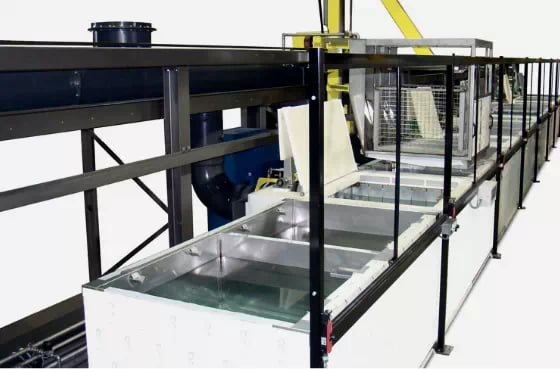
Automated immersion systems transfer parts through a sequence of cleaning, rinsing, chemical treatment, and drying stations. Recipes define the processing conditions and handling sequence for each workpiece.
Built around your process
Also known as automated dip tanks, surface treatment lines, and multi-stage immersion systems, these lines combine configurable tanks with automated handling and process controls.
02 / INSIDE THE LINE
From contaminated part to prepared surface
- 1
Pre-cleaning & degreasing
Remove oils, machining fluids, grease, and production contaminants. Ultrasonics, agitation, or spray assistance can support contaminant removal.
- 2
Rinsing
Remove residual chemistry before the next tank. Multiple rinse stages help limit chemical carryover and preserve bath conditions.
- 3
Surface Preparation
Use application-specific etching, pickling, activation, or descaling to prepare your substrate for subsequent treatment.
- 4
Chemical Surface Treatment
Anodizing, phosphating, conversion coating, plating, penetrant application or passivation changes the surface according to your corrosion, adhesion, or wear requirements.
- 5
Final rinse and drying
Remove remaining chemistry and dry your parts for inspection, assembly, coating, or shipment.
Your process recipe must reflect material compatibility, cleanliness requirements, and the intended surface treatment. Each process sequence is tailored to the specific application.
03 / SYSTEM ARCHITECTURE
The technologies behind consistent results
Process tanks
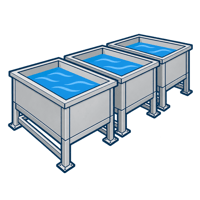
Separate cleaning, rinsing, and treatment baths preserve the sequence your workpiece requires. Tank count follows process complexity.
Transfer hoists
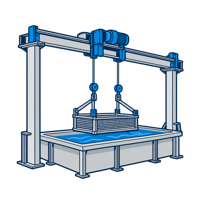
Programmed handling controls dwell time and transfer speed, keeping exposure consistent across production batches.
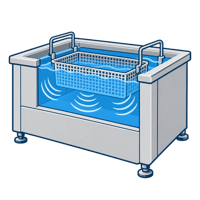
Ultrasonic cleaning
Cavitation helps dislodge fine contaminants from precision surfaces and complex features where direct spray access is limited.
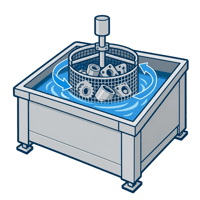
Agitation and rotation
Workpiece or solution movement improves chemical contact by reducing stagnant boundary layers.
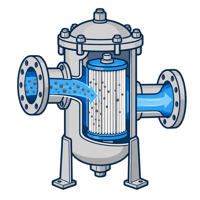
Filtration
Removing contaminants from circulating solution supports bath cleanliness and extends useful bath life.
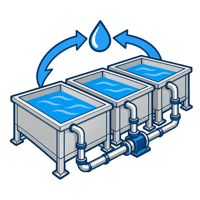
Water recovery
Rinse-water recycling and drag-out control reduce fresh-water demand and chemical carryover when designed for your process.
Select chemistry around your substrate and finish
Material compatibility and the applicable process specification determine the treatment sequence.
Chemical cleaning
Removes oils, particulates, manufacturing residues, and corrosion byproducts.
Acid etching
Prepares a chemically active surface for subsequent finishing.
Anodizing
Supports corrosion resistance, wear resistance, and durability on suitable aluminum components.
Phosphating
Supports corrosion protection and paint adhesion.
Passivation
Removes free iron from stainless steel to support corrosion resistance.
Conversion coatings
Form protective surface layers for corrosion protection and coating adhesion.
Fluorescent Penetrant Inspection
Ideal for revealing flaws, cracks and signs of fatigue, and for exposing metal grain structure. Learn More about our FPI systems
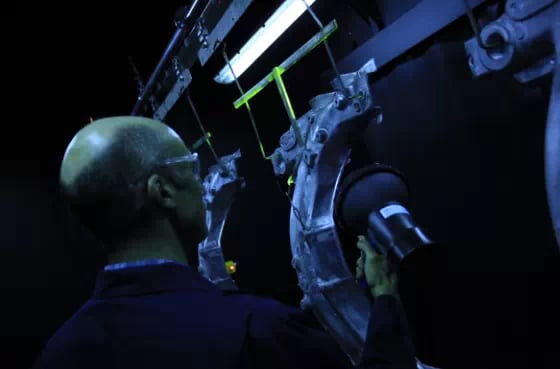
Fluorescent Penetrant Inspection Immersion Systems (FPI)
Each liquid penetrant and FPI system is custom-designed to meet the customer's specifications, parts, and production output criteria.
04 / COMPARE YOUR OPTIONS
Immersion cleaning vs. spray cleaning
Choose based on the part and process. Performance depends on access, fixturing, chemistry, and validation.
| Immersion and spray: application considerations | ||
| Consideration | Automated Immersion | Spray Cleaning |
| Complex geometries | Fluid contact with accessible internal features. | Depends on spray access and orientation. |
| Surface treatment | Suited to many bath-based chemical processes. | Suited to compatible spray processes. |
| Production throughput | Scalable with handling and tank capacity. | Scalable with conveyor or batch design. |
| Delicate parts | Evaluate agitation and chemistry. | Evaluate pressure and workholding. |
| Investment | Multiple tanks and automated handling add capital requirements. | Configuration and process complexity drive equipment cost. |
| Start with process validation Confirm the cleaning method against your actual workpieces and acceptance criteria before selecting equipment |
05 / OPERATIONAL VALUE
Why manufacturers choose automated immersion processing
Repeatability
Control processing time, temperature, chemistry, and transfer conditions.
Cleaning Performance
Combine immersion with suitable ultrasonics or agitation for challenging features.
Production Flow
Coordinate transfers and reduce manual handling bottlenecks.
Quality Control
Support consistent processing across batches and shifts.
Traceability
Capture process conditions, batch history, and quality records.
Resource Efficiency
Reduce avoidable water and chemical losses through appropriate system design.
06 / PLAN FOR IMPLEMENTATION
Evaluate the complete operating environment
Capital & facility needs
Account for automation, floor space, utilities, ventilation, and wastewater treatment. Learn moreChemistry & process engineering
Plan bath monitoring, filtration, material compatibility, and maintenance access. Learn more
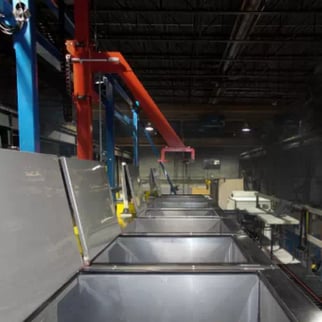
Capital & facility needs
Account for automation, floor space, utilities, ventilation, and wastewater treatment. Learn more
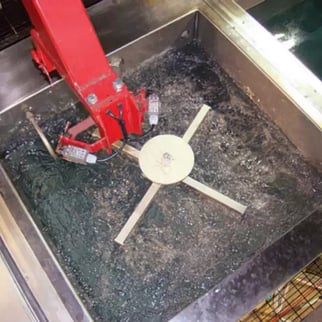
Chemistry & process engineering
Plan bath monitoring, filtration, material compatibility, and maintenance access. Learn more07 / INDUSTRY APPLICATIONS
Designed for demanding workpieces
Aerospace OEM and MRO
Engine components, pre-inspection cleaning, chemical treatment, and overhaul processes.
Automotive & Tier Suppliers
Gears, transmission components, powertrain parts, and ring-and-pinion assemblies.
Precision Manufacturing
Complex machined parts with internal passages, threaded features, and demanding cleanliness requirements.
Heavy Equipment
Rebuilding, maintenance, forged components, and industrial assemblies.
08 / SELECTION & ROI
Define the process before the equipment
- 1
Set your expected process outcomes
Define the expected process outcomes, acceptance criteria, and contamination or surface condition requirements (i.e., cleaning, etching, plating, penetrant inspection) to establish clear validation standards.
- 2
Evaluate geometry
Identify blind holes, cavities, internal channels, and sensitive surfaces that affect fluid contact and drainage.
- 3
Map process stages
Define cleaning, rinsing, surface treatment, and drying requirements before sizing tanks or selecting handling equipment.
- 4
Set throughput goals
Specify parts per hour, shift patterns, and anticipated growth to balance dwell times with transfer capacity.
- 5
Define automation
Determine handling, robotics, and MES or ERP connectivity requirements based on your production environment.
- 6
Calculate ownership cost
Include water, chemistry, energy, maintenance, labor, and downtime alongside equipment and installation costs.
OUR PARTNERS
Maximize line performance while lowering operating costs
Standardize work holding. Consistent fixturing supports repeatable contact, handling, and drainage.
Reduce drag-out. Limit solution retained on workpieces to reduce carryover and chemistry loss.
Evaluate counterflow rinsing. Multi-stage rinsing can reduce water demand while maintaining rinse quality.
Plan for expansion. Allow space and process capacity for additional stages as requirements evolve.
Monitor bath conditions. Record process data to support quality review and troubleshooting.
09 / WHAT`S NEXT
More connected. More traceable. More efficient.
Industry 4.0 connectivity, remote diagnostics, sensor-based maintenance, and digital batch records can extend your visibility into production. Advanced ultrasonic configurations and water-recovery systems should be evaluated against your component types, chemistry, and resource targets, rather than specified as universal requirements.
|
Connected production Real-time monitoring, remote diagnostics, and production-system integration. |
|
Condition monitoring Sensor data to support maintenance planning and early issue detection. |
|
Ultrasonics Frequency selection matched to the workpiece and cleaning objective. |
|
Sustainability engineering Water reuse, energy efficiency, and chemical conservation. |
| PROCECO Surface Treatment Systems integrate automated cleaning with processes such as acid etch, anodizing, and phosphating. Define your workpiece and process requirements before choosing your configuration. |
Go deeper into your process
The ROI of custom engineering →
Water Recycling to Reduce Cost of Surface Treatment →
Enhancing Aerospace Precision with Aqueous Parts Washers →
Features To Consider When Choosing a Parts Washer →
5-Stage immersion cleaning system for used aircraft engine parts →
Cleaning and anodizing line for aircraft propeller blades →
8-Stage cleaning system for used jet engine parts prior to MRO →