

Introduction
When manufacturers evaluate a new industrial parts washer, the initial equipment price is often one of the first numbers compared. A standard machine may appear to be the most economical option based on purchase price alone.
However, a lower initial price does not always mean a lower operating cost. A washer that is not properly matched to the application can create longer cycle times, manual touch-ups, repeat cleaning cycles, and excessive utility consumption. Over time, these inefficiencies can prevent the washer from keeping pace with production and turn cleaning into a bottleneck.
These costs rarely appear on the original quotation, but they accumulate throughout the machine’s life. Custom engineering takes a different approach by designing the cleaning system around the component, contamination, production rate, cleanliness requirements, and manufacturing environment.
The important question is not simply whether a custom system costs more initially, but when that additional investment generates a measurable return.
Engineering Around the Application
Every cleaning application begins with the part. Its geometry, size, weight, material, contamination, and required cleanliness determine how it should be cleaned. A large component covered in machining chips and oil presents a different challenge from a precision component with internal passages or stringent cleanliness requirements.
Production requirements are equally important. Engineers must consider parts per hour, allowable cycle time, and whether components are processed individually, in batches, or continuously.
The manufacturing environment also influences the design. Floor space, utilities, operator interaction, lifting requirements, conveyors, fixtures, and other material-handling equipment must be considered to ensure the washer integrates effectively into production.
Designing for the Production Environment
The cleaning system does not operate independently from the rest of the factory. In automated environments, the washer may need to communicate with conveyors, robots, manufacturing systems, or other equipment. Loading and unloading methods must also support the required production rate.
Filtration and solution management should reflect the actual contamination of load. Applications producing large quantities of chips or oil require a different approach from those dealing with light particulate contamination.
Maintenance of access should also be incorporated into the design. Pumps, filters, nozzles, tanks, heaters, sensors, and other components should remain accessible to minimize maintenance-related interruptions.
Safety and ergonomics are equally important. The system should minimize unnecessary lifting, repetitive handling, awkward movements, and operator exposure wherever practical.
When these requirements are considered together, customization becomes less about adding features and more about removing inefficiencies.
Where the ROI Comes From
The return on custom engineering rarely comes from one dramatic improvement. More often, it results from operational gains that accumulate across every shift and production cycle.
Higher Throughput
Cleaning equipment should support production, not limit it. When a washer is engineered around the whole process, it becomes easier to optimize the cleaning system for the application.
This can eliminate unnecessary steps, reduce handling, and match capacity to production task time. Even small cycle-time improvements become significant when repeated thousands of times. Saving one minute across 50 cycles per shift and hundreds of operating days can recover considerable production time.
Lower Labor Requirements
Manual cleaning may require operators to load and reposition parts, move them between stations, perform additional rinsing or drying, inspect results, and repeat cleaning when necessary.
Custom engineering can automate many of these tasks. Fixtures position components correctly, automated cycles ensure a repeatable process, and material-handling systems reduce manual handling.
The objective is not simply to reduce labor but to use it more effectively, allowing skilled employees to focus on production, quality, maintenance, and other higher-value activities.
Consistent Cleaning Quality
Contamination can remain in blind holes, internal passages, cavities, and recessed surfaces even when a part is visually clean. Custom systems can target these areas through engineered part orientation, dedicated spray manifolds, fixtures, rotation, agitation, and filtration.
Greater repeatability helps components consistently meet cleanliness specifications. This reduces the need for manual cleaning, rework, and rejection while preventing contamination-related problems in downstream processes such as coating, assembly, inspection, and testing.
Reduced Operating Costs
A larger pump, heater, tank, or filtration system is not automatically better. Oversized equipment means paying for excess capacity every time the machine operates.
Custom engineering allows pressure, flow, heating, filtration, and solution capacity to match actual process requirements. Over years of operation, differences in energy, water, chemicals, maintenance, and process efficiency can become more significant than the initial difference in purchase price.
Calculating the Business Case for Custom Engineering
A practical business case can compare the proposed cleaning system with the current process or a standard equipment alternative using measurements such as:
-
Parts cleaned per hour
-
Labor hours per shift
-
Rework and rejection rates
-
Water, energy, and chemical consumption
-
Maintenance requirements
-
Planned and unplanned downtime
-
Expected equipment service life
The key is to evaluate these numbers over time. Small labor, energy, or cycle-time savings may have limited impact in low-volume applications but become substantial when thousands of components are processed every week.
The same applies to quality and downtime. Reducing repeat cleaning by a few percentage points can recover significant annual capacity, while washer downtime on an automated line can directly reduce throughput or stop production.
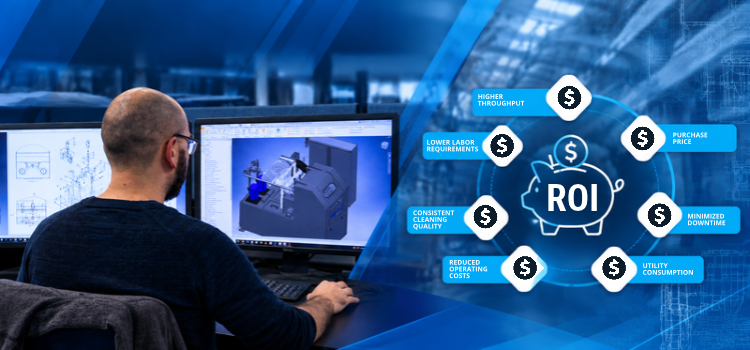
Together, higher production volumes, lower labor requirements, consistent cleanliness, operating efficiency, and minimized downtime contribute to the return on investment.
PROCECO's Application-Driven Engineering Approach
At PROCECO, the engineering process begins by understanding the application rather than selecting a machine from a catalogue and adapting the process around it. The component, contamination, required cleanliness, production rate, material handling, utilities, floor space, and surrounding operations are evaluated before the cleaning process is fully defined.
Every design decision should address a measurable production, cleaning, maintenance, safety, or handling requirement. This approach is particularly valuable in aerospace, heavy equipment, automotive, rail and transit, and general manufacturing, where cleaning requirements vary considerably.
In these applications, the washer becomes part of the manufacturing process, and its performance must support the operation around it.
Engineering for Lifecycle Value
Standard equipment can be the right solution when an application fits its capabilities. Custom engineering becomes valuable when adapting the process to a standard machine compromise throughput, labor, quality, operating cost, material handling, or integration.
Higher productivity, consistent cleaning results, reduced manual intervention, efficient utility use, easier maintenance, and avoided downtime can all contribute to the business case. Repeated across thousands of production cycles and years of operation, their cumulative value can exceed the difference in initial equipment cost.
Ultimately, the most economical industrial parts washer is not necessarily the one with the lowest purchase price. It is the one engineered to reliably meet production and cleanliness targets throughout its operating life.
|
Are you ready to find out if custom engineering can deliver a more powerful return on your cleaning process? |