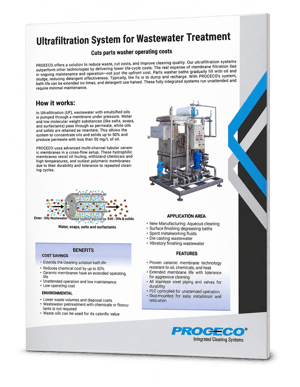
Ultrafiltration system for wastewater treatment
Advanced ceramic membrane ultrafiltration technology removes oils and suspended contaminants from industrial process streams, enabling wastewater recycling, improved cleaning performance, and lower lifecycle operating costs.
01 /
What Is Ultrafiltration (UF)?
Ultrafiltration is a pressure-driven membrane separation process that removes emulsified oils, grease, suspended solids, and other high-molecular-weight contaminants from wastewater.
The process works by forcing wastewater through specialized membrane pores:
| Water passes through as permeate | Soaps and selected dissolved compounds remain available for reuse | |
| Oils and suspended solids are retained as concentrate (retentate) | The concentrated waste stream is reduced in volume for easier disposal |
Unlike conventional oil-water separators, UF technology can effectively remove emulsified oils, which do not naturally separate from water. PROCECO UF systems can produce permeate containing less than 50 mg/L of oil while concentrating oils and solids up to 50% concentration.
| Key Takeaway: Ultrafiltration bridges the gap between simple oil separation and full wastewater treatment by removing difficult-to-separate emulsified oils while preserving reusable water and cleaning chemistry. |
03 /
Why Oily Wastewater Is a Major Challenge
In industrial cleaning applications, oils and contaminants gradually accumulate in process baths. As contamination levels rise:
-
Detergent effectiveness declines
-
Cleaning quality becomes inconsistent
-
Rework increases
-
Bath replacement frequency rises
-
Chemical costs escalate
- Waste disposal volumes grow
Many facilities still rely on a "dump and recharge" strategy, replacing entire cleaning baths when performance deteriorates. While simple, this approach results in unnecessary chemical consumption, downtime, and wastewater disposal expenses.
Ultrafiltration changes this equation by continuously removing oil contamination before it impacts process performance.
05 /
Understanding Free Oil vs. Emulsified Oil
One of the most important concepts in wastewater treatment is understanding the difference between free oil and emulsified oil.
| Characteristic | Free Oil | Emulsified Oil | |
| Separation Behavior | Naturally rises to the surface | Remains suspended in water | |
| Removal Method | Skimmers, coalescers, gravity separation | Membrane filtration required | |
| Stability | Separates relatively easily | Bound by surfactants and detergents | |
| Treatment Complexity | Low | High |
Emulsified oil, however, is stabilized by detergents, surfactants, and electrical charges. Because the oil droplets remain dispersed throughout the water, specialized technologies such as ultrafiltration are required for effective removal.
02 /
How PROCECO Ultrafiltration Systems Work
PROCECO UF systems utilize advanced multi-channel tubular ceramic membranes operating in a cross-flow configuration. This design minimizes membrane fouling and promotes long-term reliability.
- 1
Step 1: Wastewater Collection
Oily wastewater enters the process tank where it is prepared for filtration.
- 2
Step 2: High-Flow Circulation
A process pump continuously circulates the solution through the membrane modules. High cross-flow velocity helps keep the membrane surface clean and reduces buildup.
- 3
Step 3: Membrane Separation
Pressure forces water and low molecular weight substances through the membrane. These typically include:
- Water
- Dissolved Salts
- Low molecular weight organics
- Surfactants
At the same time, oils and suspended solids remain on the feed side of the membrane.
- 4
Step 4: Permeate Recovery
Clean permeate exits the system and can be returned to the cleaning process or used elsewhere in the operation.
- 5
Step 5: Waste Concentration
As filtration continues, oils and solids become increasingly concentrated, dramatically reducing disposal volumes. Once the cycle is complete, the concentrated waste stream can be removed for disposal or energy recovery.
04 /
Why Ceramic Membranes Outperform Conventional Membranes
Not all UF systems are created equal. Many systems use polymeric membranes that can suffer from:
| Premature fouling | Chemical degradation |
| Temperature limitations | Shorter service life |
PROCECO employs hydrophilic ceramic membrane technology, offering several significant advantages:
Chemical Resistance
Ceramic membranes withstand aggressive cleaning chemicals and detergents without degradation.
High Temperature Tolerance
Industrial processes often operate at elevated temperatures. Ceramic membranes maintain performance under demanding thermal conditions.
Superior Fouling Resistance
Hydrophilic surfaces naturally resist oil attachment, minimizing fouling and maintaining filtration efficiency.
Longer Operating Life
Because they tolerate repeated cleaning cycles and harsh operating environments, ceramic membranes typically provide substantially longer service life than polymeric alternatives.
06 /
Applications for Ultrafiltration Systems
UF systems are particularly effective in manufacturing environments where oils contaminate aqueous process streams.
Aqueous Parts Cleaning
Continuous oil removal maintains detergent effectiveness and cleaning consistency.
Surface Finishing Degreasing Baths
Extends solution life while improving downstream process quality.
Spent Metalworking Fluids
Reduces disposal volumes and enables recovery of reusable process water.
Die Casting Wastewater
Removes emulsified oils and fine particulates generated during production.
Vibratory Finishing Wastewater
Improves wastewater quality while reducing treatment and hauling costs.
08 /
Business Benefits of Wastewater Recycling with Ultrafiltration
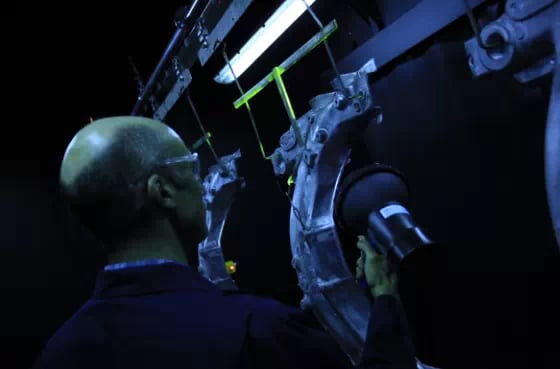
Fluorescent Penetrant Inspection Immersion Systems (FPI)
Each liquid penetrant and FPI system is custom-designed to meet the customer's specifications, parts, and production output criteria.
Extend Cleaning Bath Life
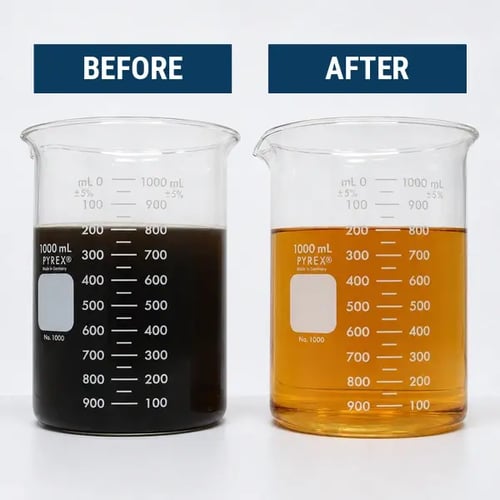
PROCECO UF systems can extend cleaning solution life by as much as six times, reducing downtime and replacement frequency.
Reduce Chemical Consumption
By preserving active cleaning chemistry while removing contaminants, detergent usage can be reduced by up to 50%.
Lower Disposal Costs
Concentrating oils and solids significantly reduces the volume of waste requiring disposal.
Improve Cleaning Performance
Cleaner baths produce more consistent cleaning results and help maintain production quality.
Minimize Operator Intervention
Automated PLC-controlled operation allows unattended processing and reduced labor requirements.

10 /
Best Practices for Maximizing UF Performance
Monitor Oil Concentration
Excessive contamination can reduce throughput. Routine monitoring helps optimize membrane performance.
Establish Preventive Cleaning
Even highly durable ceramic membranes benefit from regular cleaning to maintain peak efficiency.
Integrate Continuous Treatment
Treating wastewater continuously rather than intermittently often delivers better bath stability and longer solution life.
Consider Closed-Loop Water Reuse
Combining UF with technologies such as evaporators can significantly reduce freshwater consumption and wastewater discharge.
Go deeper into your process
Water Recycling to Reduce Cost of Surface Treatment (Blog) →
Cleaning solution – when is it time to replace it? (Blog) →
Understanding the Environmental Impact of Aqueous Parts Washers (Blog) →
Increase Production and Improve Performance with Industrial IOT (Blog) →
PROCECO Éco-Smart® Wastewater Treatment System (Brochure) →